Introduction
Picture this: you invest in powder-coated machinery or outdoor equipment, and five years later it still looks nearly new. Ten years pass, and it's holding strong. Meanwhile, a competitor's powder-coated product from the same year is already showing chalking and rust spots. What's the difference?
Professionally applied powder coating typically lasts 15–20 years under normal conditions—but that number can shrink to just 5–10 years or stretch beyond 30 years depending on three factors: surface preparation quality, environmental exposure, and ongoing maintenance.
Powder coating is an electrostatically charged dry powder applied to metal surfaces, then heat-cured in an oven to form a hard, chemically bonded finish. Unlike liquid paint, the particles fuse into a uniform protective layer that resists chipping, fading, and corrosion—making it a preferred finish for industrial and outdoor applications. This guide breaks down exactly what determines how long that protection holds.
Key Takeaways
- Powder coating lasts 15–20 years under typical conditions with proper application
- Indoor applications often exceed 20 years; outdoor coastal environments may see 10–15 years
- Surface preparation—especially media blasting—is the single biggest factor in longevity
- UV radiation, moisture, salt, and chemicals are the primary enemies of powder coating
- Gentle cleaning extends coating life — abrasive scrubbers and physical impacts shorten it fast
How Long Does Powder Coating Actually Last?
Typical Lifespan: Indoor vs. Outdoor
The industry-standard lifespan of 15–20 years applies to professionally applied powder coating under moderate environmental conditions with reasonable maintenance. This benchmark assumes proper surface preparation, controlled curing, and consistent film thickness, all of which are covered in detail below.
Indoor vs. outdoor performance creates a clear split:
- Indoor applications (appliances, shelving, gym equipment, electronics enclosures) routinely exceed 20 years with minimal degradation because they avoid the two biggest coating destroyers: UV radiation and moisture cycling
- Outdoor applications (railings, patio furniture, architectural panels) face constant assault from sunlight, rain, temperature swings, and airborne pollutants, typically reducing effective lifespan to 10–15 years without enhanced formulations
This lifespan advantage over liquid paint is substantial. Traditional liquid paint typically requires recoating after 5–10 years, while powder coating's thermally cured polymer bond delivers 2–3 times longer protection with far less maintenance.
Lifespan by Application Type
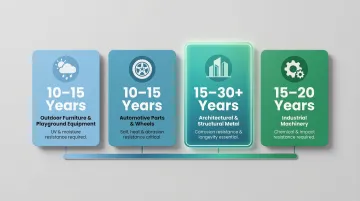
Identical powder coating applied to different environments produces vastly different outcomes. Here's what to expect across common use cases:
| Application | Typical Lifespan | Key Conditions |
|---|---|---|
| Outdoor furniture & playground equipment | 10–15 years | Heavy UV and weather cycling require super-durable polyester formulations; commercial playground specs call for a three-layer system: zinc-rich epoxy primer, barrier coat, UV-resistant topcoat |
| Automotive parts & wheels | 10–15 years | Road salts, brake dust, and abrasion demand acrylic or super-durable polyester powders to hold gloss and color |
| Architectural & structural metal | 15–30+ years | Building facades using AAMA 2605 fluoropolymer powders carry up to 30-year film integrity warranties; indoor structural steel easily exceeds 20 years |
| Industrial machinery | 15–20 years | Epoxy-polyester hybrids handle chemical exposure and temperature extremes indoors; outdoor corrosive environments may cut that to 10–15 years |
Geography matters just as much as application type. A powder-coated railing in coastal Miami degrades far faster than the same coating in dry Phoenix — salt air and humidity accelerate failure in ways that inland arid climates simply don't.
What Factors Affect Powder Coating Lifespan?
Environmental Exposure
UV radiation breakdown: Sunlight is powder coating's primary enemy. UV rays break the covalent bonds in the polymer resin, causing three progressive failure modes:
- Chalking - White powdery residue appears as the binder degrades and exposes pigment particles
- Color fade - Pigments lose vibrancy, measured in Delta E units (one unit = smallest visible color change)
- Gloss loss - Surface becomes dull and rough as UV micro-fractures the coating
Standard polyester formulations (AAMA 2603) show visible degradation after just one year of South Florida exposure. UV-resistant super-durable polyesters (AAMA 2604) maintain performance for 5+ years, while FEVE fluoropolymer powders (AAMA 2605) deliver 20–30 years of color and gloss retention.
Moisture and humidity acceleration: High humidity accelerates coating failure, especially when thin spots or adhesion gaps exist. Moisture infiltrates microscopic pores, creating osmotic pressure that causes blistering and delamination. Coastal and high-rainfall environments present the highest risk because water vapor carries dissolved salts that attack both coating and substrate.
Chemical and salt exposure: Industrial fallout, road salt (sodium chloride), and saltwater proximity corrode coatings faster than standard atmospheric exposure. Salt spray testing (ASTM B117) measures this resistance—properly prepared powder-coated steel should survive 3,000+ hours without failure, while poorly prepared surfaces fail in under 500 hours.
Surface Material and Conductivity
Surface preparation and material selection shape lifespan just as much as the coating itself — often more.
Metal conductivity matters: Powder coating relies on electrostatic attraction between negatively charged powder particles and grounded metal. Steel, aluminum, and iron coat exceptionally well due to high conductivity. Low-conductivity metals (titanium, tungsten) produce weaker electrostatic bonds and shorter-lived finishes.
Surface condition is everything: The metal's condition before coating determines long-term adhesion more than any other factor. Contaminants create weak spots that become failure pathways:
- Rust and mill scale - Prevent direct coating-to-metal contact
- Oil and grease - Block adhesion and cause fisheyes
- Surface oxidation - Creates unstable interface layer
- Existing coatings - May delaminate under new powder
To reach 3,000–4,000 hours of salt spray resistance, applicators blast to SSPC-SP10 (Near-White Metal) standard and follow with chemical conversion coating. This removes 95% of contaminants and creates a mechanical anchor profile that measurably improves adhesion.
Quality of Application
Coating thickness and consistency: Uneven application leaves thin areas vulnerable to chipping and corrosion infiltration. Industry standards specify 2.0–4.0 mils (50–100 µm) dry film thickness. Too thin compromises protection; too thick causes internal stress, mud cracking, and chipping.
Curing temperature and time: The most common application failure point is curing. Curing depends on the part's actual metal temperature, not the oven's air temperature — a distinction many applicators overlook. A part must reach the specified temperature (typically 400°F) for the full time (typically 10 minutes) to achieve complete crosslinking.
Both failure modes carry real costs:
- Under-cured coatings look fine but become brittle, lose chemical resistance, and chip early. The MEK double-rub test (ASTM D4752) detects this — properly cured powder withstands 50+ double rubs without breaking down.
- Over-cured coatings suffer polymer degradation, causing yellowing, gloss loss, and reduced impact resistance.
Professional applicators use thermocouple data logs to validate cure quality before shipment.
How to Make Powder Coating Last Longer
Start with Proper Surface Preparation
Surface preparation is the single most impactful step in maximizing powder coating lifespan. No amount of high-quality powder or perfect application technique can compensate for contaminated or corroded surfaces.
The surface prep hierarchy:
- Degreasing - Remove oils, cutting fluids, and handling residue
- Rust removal - Eliminate all oxidation and corrosion products
- Abrasive preparation - Create mechanical anchor profile
Media blasting: the most effective prep method
Abrasive blasting removes rust, scale, old coatings, and contaminants while creating a profile that improves mechanical adhesion. Professional specifications call for SSPC-SP10 (Near-White Metal) cleanliness, which removes 95% of surface contamination and allows only minor random staining.
The abrasive media creates a surface profile depth of 1.0–3.0 mils (25–75 µm)—deep enough for excellent mechanical grip, but not so deep that peaks protrude through the cured film.
IMTS provides media blasting using both glass bead and coal slag media as part of their pre-coating prep, keeping fabrication and finishing under one roof.
Conversion coatings add critical protection:
After blasting, bare steel remains highly reactive. Chemical conversion coatings passivate the metal and retard corrosion spread if the powder film is breached:
- Iron phosphate - Improves adhesion for indoor, light-duty environments
- Zinc phosphate - Forms dense passivation layer; increases salt spray survival 1.5–2× for heavy industrial and coastal applications
- Zirconium/nano-ceramic - Chrome-free eco-friendly alternative with excellent corrosion inhibition
IMTS includes iron phosphate chemical film washing in their powder coating workflow for improved adhesion and corrosion resistance on finished components.
Post-Coating Maintenance
Powder coating is low-maintenance by design, but neglect still shortens lifespan. Failure to clean powder-coated surfaces can void manufacturer warranties.
Proper cleaning protocol:
- Use mild soap (dish detergent) and water with soft cloth or sponge
- Clean every 3–6 months in coastal/industrial environments (ISO 12944 C4/C5)
- Clean every 12–18 months in inland/moderate environments (ISO 12944 C3)
- Rinse thoroughly to remove soap residue and dissolved pollutants
Maintenance mistakes that destroy coatings:
- Abrasive scrubbers - Steel wool, scouring pads, and stiff brushes physically scratch through the coating
- Harsh chemicals - Solvents, acids, and alkaline cleaners degrade the polymer binder
- Pressure washers - High-pressure water can penetrate coating edges and force moisture under the film
- Wire brushes - Create deep scratches that expose bare metal to corrosion
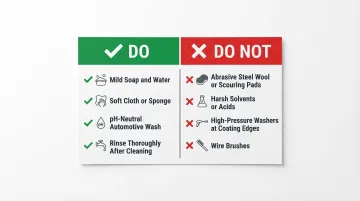
Safe cleaning products: Simple Green, mild dish soap, automotive wash solutions (pH-neutral), and dedicated powder coating cleaners. Avoid anything labeled "heavy-duty degreaser" or containing methyl ethyl ketone (MEK), acetone, or mineral spirits.
Signs Your Powder Coating Is Failing
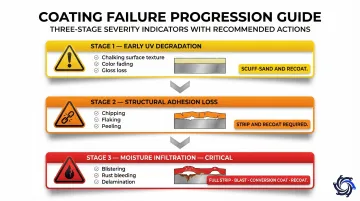
Recognizing early warning signs allows intervention before catastrophic failure exposes bare metal to corrosion.
Early visual indicators (UV degradation):
- Chalking: A dull, powdery residue left on your hand when you rub the surface — the UV binder is breaking down
- Fading: Color washes out or shifts hue as pigments degrade from prolonged sun exposure
- Gloss loss: The surface turns matte or satin where it was once glossy, caused by UV micro-roughening
At this stage, the coating has lost its UV-protective and aesthetic properties, but the bond is still intact. Light scuff-sanding and recoating is usually enough — you don't need to strip down to bare metal yet. That changes once structural failures appear.
Serious structural failures (adhesion loss):
- Chipping: Coating breaks away at edges, corners, and impact points, leaving bare metal exposed
- Flaking: Large sections separate from the substrate, typically starting at edges and working inward
- Peeling: Coating lifts and pulls away in sheets — adhesion has failed across a wide area
Once bare metal is exposed, rust spreads beneath the coating faster than it spreads on an open surface — moisture wicks under intact sections through micro-gaps, widening the damage. Stripping and recoating are required at this point.
Critical failure indicators (moisture infiltration):
- Bubbling/blistering: Raised bumps beneath the surface mean moisture is trapped — the bond is already compromised
- Rust bleeding: Orange or brown staining spreading outward from chips or edges signals active corrosion underneath
- Delamination: The coating separates from the substrate without fully peeling; it looks intact but has lost adhesion entirely
Visible blistering means moisture or soluble salts were trapped during application and have since undermined the bond. Spot repairs won't hold — moisture keeps migrating beneath the surrounding coating. The only fix is full stripping, thorough surface prep, and recoating from scratch.
Powder Coating vs. Paint: Which Lasts Longer?
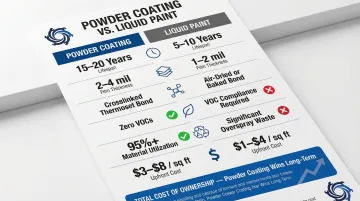
Traditional liquid paint requires significant recoating after 5–10 years due to fading, chipping, and weathering. Powder coating regularly delivers 15–20 years of protection with minimal maintenance—a 2–3× advantage in functional lifespan.
Why Powder Coating Outlasts Paint
The thermally cured polymer bond creates a finish 2–4 mils thick, compared to 1–2 mils for liquid paint. That added thickness is only part of the story. The crosslinked thermoset structure resists solvents, abrasion, and impact far better than air-dried or baked liquid paints, making it a fundamentally more durable barrier for metal surfaces.
That said, paint isn't obsolete. It holds practical advantages in specific situations:
- Brush or spray on-site for field repairs—powder coating requires factory equipment
- Works on wood, plastic, and composites without special surface prep
- Lower startup cost for small jobs that don't justify electrostatic equipment
Total Cost of Ownership
Powder coating costs more upfront—typically $3–$8 per square foot vs. $1–$4 for basic paint. Over a product's full service life, though, the math shifts. Applied material runs approximately $0.21 per square foot for powder vs. $0.52 per square foot for liquid polyurethane, largely because overspray reclamation pushes material utilization above 95%.
Environmental compliance is another cost factor. Powder coating contains zero VOCs, eliminating thermal oxidizer requirements and hazardous waste disposal costs that liquid paint operations routinely carry. Fewer regulatory obligations mean lower overhead—and less paperwork.
Frequently Asked Questions
How long should powder coating last on metal?
Professionally applied powder coating on metal typically lasts 15–20 years under normal conditions. This assumes proper surface preparation (media blasting and conversion coating), quality application with controlled curing, and reasonable environmental exposure. Indoor applications often exceed 20 years, while outdoor coastal environments may see 10–15 years.
Is it cheaper to paint or powder coat?
Powder coating costs more upfront ($3–$8 per sq ft vs. $1–$4 for paint) but delivers lower total cost of ownership over time. Its 2–3× longer lifespan (15–20 years vs. 5–10 for paint), reduced maintenance, and >95% material utilization through overspray reclaim offset the initial premium.
Is it worth powder coating stainless steel?
Stainless steel is naturally corrosion-resistant, so powder coating is less critical than with mild steel. That said, it adds color options, improves scratch resistance, and strengthens protection in harsh chemical or marine environments—making it worthwhile for aesthetic or extreme-duty applications.
Does powder coating scratch off easily?
Powder coating is far more scratch-resistant than standard paint—its crosslinked thermoset structure and 2–4 mil thickness resist everyday abrasion. It's not scratch-proof, though: deep impacts can chip through, particularly at edges and corners. Touch up any exposed metal promptly to prevent corrosion from spreading beneath the coating.
Does powder coating last longer indoors or outdoors?
Indoor powder coating consistently outlasts outdoor applications because it avoids UV degradation, moisture cycling, and temperature extremes. Indoor-coated items routinely exceed 20 years with minimal maintenance, while outdoor applications typically achieve 10–15 years depending on climate, UV exposure, and proximity to salt or industrial pollutants.
How do you know when powder coating needs to be redone?
Watch for chalking (powdery surface residue), peeling or flaking that exposes bare metal, rust spots spreading from chips, and blistering under the finish. Once bare metal is exposed or moisture has infiltrated the coating, complete recoating—after stripping, blasting, and conversion coating—is required rather than spot repair.
Ready to maximize the lifespan of your metal components? IMTS provides complete powder coating services with integrated media blasting and chemical conversion coating—all performed in-house to ensure optimal surface preparation and coating adhesion. Contact IMTS at (607) 345-3050 or info@imtsny.com to discuss your project requirements and get a clear assessment of what your application needs to hit 15–20+ year coating performance.