Introduction
Corrosion is one of the most expensive threats to metal components in industrial operations, with global costs reaching $2.5 trillion annually—equivalent to 3.4% of worldwide GDP. Left untreated, surface rust accelerates fast, turning minor surface oxidation into structural damage that demands full replacement rather than repair.
Effective treatment goes beyond scrubbing off rust. You need to match the removal method to the corrosion severity, protect the base metal during treatment, and apply a barrier coating immediately after to stop re-oxidation.
This guide covers corrosion assessment, removal techniques ranging from DIY approaches to professional media blasting, safe execution, and prevention measures that hold up long-term.
Key Takeaways
- Assess corrosion severity first (light, moderate, or severe) — the wrong removal technique can damage base metal
- Light surface rust responds to wire brushes, white vinegar soaks, or commercial rust removers
- Moderate to severe corrosion requires powered tools or professional media blasting for complete removal
- Bare metal must receive protective coating within 0.5-2 hours after cleaning to prevent flash rust
- Call professionals for structural parts, large areas, or when powder coating and dimensional accuracy matter
What Is Corrosion and What Causes It?
Corrosion is the electrochemical degradation of metal caused by reaction with environmental elements—primarily oxygen, moisture, and chemicals. Unlike cosmetic damage, corrosion converts solid metal into brittle oxide compounds that flake away, exposing fresh material to continued attack.
Different metals corrode distinctly. Steel and iron form iron oxide (rust) following the reaction 4Fe + 3O₂ + 2H₂O = 2Fe₂O₃·H₂O, creating a porous, non-protective layer that accelerates further degradation. Aluminum develops a thin aluminum oxide (Al₂O₃) passivation layer that's self-limiting and protective, stopping deeper corrosion.
Copper forms the familiar green patina (copper carbonate) that similarly protects underlying metal. These differences matter — the removal method that works for steel can damage aluminum, and vice versa. Root causes shape which approach is appropriate.
Primary root causes include:
- Moisture above 40% relative humidity significantly accelerates steel corrosion
- Dissimilar metals in contact under an electrolyte cause galvanic corrosion, attacking the more reactive metal first
- Chlorides from marine or road-salt environments and industrial sulfates speed up electrochemical reactions
- Chipped or scratched coatings let moisture penetrate, triggering underfilm corrosion that spreads unseen
- Ground contact, condensation, and uncontrolled humidity in storage create ideal conditions for rapid oxidation
Types of Corrosion: Identifying Severity Before You Begin
Assessing corrosion severity before starting removal tells you which tools to reach for and prevents unnecessary damage to the base material. Start by cleaning the area with degreaser to remove oils, dirt, and debris that can obscure the true extent of corrosion.
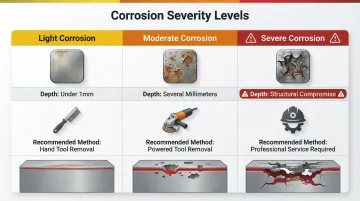
A quick visual check across three severity levels guides every decision that follows:
- Light corrosion: Surface-level discoloration, minor staining, or shallow pitting under 1mm deep. Responds well to hand tools, household chemicals, or commercial rust removers — rarely needs professional intervention.
- Moderate corrosion: Deeper pitting, flaking, scaling, or blistering that extends into the base metal. Rust scale may be several millimeters thick; powered tools, stronger chemical agents, or abrasive blasting become necessary.
- Severe corrosion: Deep pitting, exfoliation (layered lifting in aluminum alloys), or large-scale flaking that compromises structural integrity. Requires professional assessment and mechanical removal.
Light Corrosion
Light corrosion presents as surface-level discoloration, minor staining, or very shallow pitting with no visible structural compromise. The rust layer is typically less than 1mm deep and scrapes away with minimal effort. Hand tools, household chemical methods, or commercial rust removers handle this severity well.
Moderate Corrosion
Moderate corrosion shows deeper pitting, visible flaking, scaling, or blistering that extends beyond the surface layer into the base metal. Rust scale may be several millimeters thick, and some areas may require probing to determine if structural metal loss has occurred. Powered tools, stronger chemical agents, or controlled abrasive blasting become necessary at this level.
Severe Corrosion
Severe corrosion involves deep pitting that penetrates significantly into base material, exfoliation (layered lifting in aluminum alloys), or large-scale flaking that compromises part integrity. Section loss exceeding 10-15% of the original cross-section raises immediate structural concerns.
At this level, professional mechanical removal via media blasting or grinding is typically required, followed by expert surface treatment and an engineering assessment to determine if the component remains serviceable.
How to Remove Corrosion: Techniques for Every Damage Level
No single method works for all corrosion—the right technique depends on severity, metal type, part size, and required surface finish. Applying aggressive methods to light corrosion removes base material unnecessarily, while gentle methods on severe corrosion waste time and leave damaging residue.
Hand and DIY Methods (Light Corrosion)
Manual abrasive tools effectively address light surface rust:
- Wire brushes — Use brushes matching the base metal (aluminum-bristle for aluminum, stainless for stainless steel) to prevent embedding foreign particles that trigger galvanic corrosion
- Abrasive paper — 80-120 grit removes surface oxidation; finer grits polish afterward
- Abrasive wool — Non-woven pads like Scotch-Brite remove rust without gouging softer metals
- Scrapers — Plastic or brass scrapers lift flaking rust without scratching base metal
Household chemical methods work for small parts with light rust:
- White vinegar soak — Household vinegar contains 4-5% acetic acid that dissolves iron oxide. Submerge parts overnight, scrub with crumpled aluminum foil, rinse thoroughly, and dry immediately
- Baking soda paste — Mix sodium bicarbonate with water to form a thick paste, apply to rust, let sit 2-3 hours, scrub with a brush, then rinse and neutralize any residual acid
- Lemon juice and salt — The citric acid combined with salt's mild abrasive action removes light surface oxidation on small areas
Regardless of which chemical method you use, finish with a clean water rinse and dry the part immediately using compressed air or heat — any residual moisture will trigger re-corrosion within minutes.
Commercial rust removers and converters offer targeted solutions:
- Rust removers dissolve iron oxide chemically using acids (phosphoric, oxalic, or hydrochloric), stripping metal to bare substrate. They require neutralization and immediate coating to prevent flash rust
- Rust converters use phosphoric acid to chemically transform rust into stable iron phosphate (FePO₄), creating a paintable surface that increases coating adhesion. Converters work best when complete mechanical removal is impractical and light rust remains after cleaning
Powered Mechanical Methods (Moderate to Severe Corrosion)
Powered tools dramatically speed removal on larger areas:
- Angle grinders with flap discs — Overlapping abrasive flaps (36-80 grit zirconia or ceramic alumina) aggressively remove heavy scale and rust. They're fastest for severe corrosion but risk gouging base metal if pressure isn't controlled
- Wire wheel attachments — Remove loose rust, paint, and weld spatter without cutting into base material, though they can burnish rather than clean if excessive pressure is applied
- Stripping discs — Non-woven synthetic fiber discs infused with silicon carbide (like Scotch-Brite Clean and Strip) aggressively remove rust while maintaining a cool, non-loading surface that prevents gouging
Critical precaution: Aggressive grinding generates significant heat that creates Heat-Affected Zones (HAZ), altering steel microstructure and potentially causing warping, residual stresses, or loss of corrosion resistance in stainless steel. Allow metal to cool periodically during grinding, and never grind continuously in one spot.
Professional media blasting is the most effective method for heavily corroded surfaces, complex geometries, or parts requiring consistent surface profile for coating adhesion. The process propels abrasive particles at high pressure to remove corrosion without embedding contaminants: aluminum oxide for aggressive cleaning of hard metals, glass beads for softer substrates like aluminum.
For shops handling large or complex parts, having blasting and powder coating under one roof matters. IMTS, for example, performs glass bead and coal slag media blasting followed directly by powder coating on-site in Marathon, NY, eliminating the transit window where bare metal can flash rust before coating.
Chemical Removal (Specialty Applications)
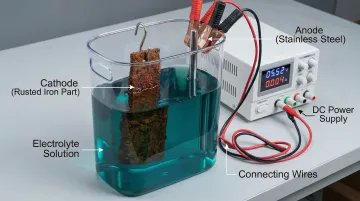
Electrolysis method works exceptionally well for intricate, delicate, or hard-to-reach areas where mechanical abrasion would alter tolerances. The process uses a low-voltage DC current (typically 2-6 volts) to transfer rust from the corroded object (cathode) to a sacrificial steel anode through a sodium carbonate or baking soda electrolyte solution.
The hydrogen bubbles mechanically lift rust while the electrochemical process reduces ferrous oxides back to stable magnetite without removing unoxidized base metal. This makes electrolysis particularly valuable for tools, hardware, and machined parts where dimensional accuracy matters.
Industrial acid pickling using hydrochloric or sulfuric acid rapidly descales heavily corroded steel in industrial settings. These strong acids require strict PPE including chemical-resistant gloves (butyl, neoprene, or nitrile), face shields, and respiratory protection. OSHA 1910.134 mandates full-facepiece respirators with acid gas canisters for concentrations up to 50 ppm HCl, and pressure-demand SCBA for IDLH (immediately dangerous to life or health) conditions. Neutralization with alkaline solution and thorough rinsing are mandatory post-treatment steps.
Step-by-Step Corrosion Removal Process
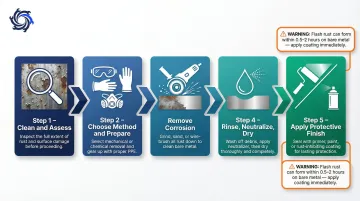
Regardless of method chosen, every corrosion removal job follows the same core sequence: clean, assess, remove, treat, protect. Skipping steps—especially the final protection step—causes rapid re-corrosion.
Step 1: Clean and Assess the Surface
Remove any paint, sealant, grease, or debris from the affected area using a solvent degreaser or alkaline cleaner per SSPC-SP 1 standards. Dry thoroughly with compressed air or heat.
Inspect under bright lighting to classify corrosion severity (light, moderate, or severe) and identify the total affected area. For larger jobs or structural components, document findings with photos and measurements for reference.
Step 2: Choose Your Method and Prepare Safely
Select the appropriate removal method based on severity assessment—reference the techniques section above. Gather required PPE: at minimum, safety gloves and eye protection for hand methods; add NIOSH-certified respiratory protection and hearing protection for powered methods or chemical treatments. Abrasive blasting requires Type CE airline respirators with positive pressure helmets per OSHA 1910.134. Set up in a well-ventilated workspace with adequate lighting.
Step 3: Remove the Corrosion
Apply the chosen removal method systematically—work from the outer edges inward to prevent spreading contaminants. Periodically wipe the surface clean and re-inspect to gauge progress. A few method-specific tips:
- Chemical methods: Follow manufacturer dwell times precisely; never let product dry on the surface
- Mechanical methods: Monitor metal temperature by touch and watch for discoloration indicating overheating
- Both: Avoid overworking any single spot, which risks excessive base metal removal
Step 4: Rinse, Neutralize, and Dry
Rinse thoroughly with clean water after any chemical treatment. Use deionized or distilled water at maximum conductivity of 5 µS/cm per SSPC Guide 15—standard tap water deposits chlorides and minerals that accelerate osmotic blistering under coatings. For acid-based treatments, apply a diluted baking soda neutralizing rinse before the final water rinse.
Dry the surface completely and immediately using compressed air, heat lamps, or forced air. Any residual moisture triggers re-corrosion before protective coating can be applied.
Step 5: Apply a Protective Finish Immediately
Bare metal should never be left uncoated after corrosion removal. Bare steel can develop flash rust within 0.5 to 2 hours in humid conditions after cleaning. Apply rust-inhibiting primer as the baseline, followed by paint, clear coat, oil film, or professional protective coating. The protective finish applied at this stage determines long-term corrosion resistance—cheap coatings fail quickly, requiring the entire process to be repeated within months.
How to Prevent Corrosion After Removal
Stripped metal is most vulnerable immediately after treatment — it has lost any natural or applied oxide layer and will begin oxidizing quickly without protection. Fast, correct coating is critical.
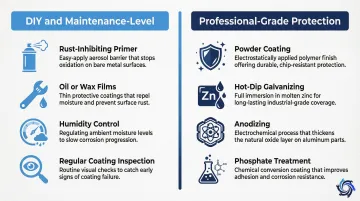
DIY and Maintenance-Level Prevention
- Apply rust-inhibiting primer (zinc chromate, epoxy, or zinc-rich formulations) before topcoat
- Use oil or wax films (like Cosmoline or WD-40) for tool surfaces and equipment in storage
- Control storage environments—maintain low humidity (below 40% RH), store off ground contact, and provide air circulation
- Inspect coatings regularly for chips, scratches, or breaches that expose base metal, and touch up immediately
Professional-Grade Corrosion Protection
- Powder coating — Electrostatically applied powder cured under heat creates a highly durable finish bonded tightly to the metal surface. Properly pre-treated powder coatings routinely withstand 750–1,500 hours of salt spray testing, with strong resistance to moisture, chemicals, and abrasion
- Hot-dip galvanizing — Provides three-fold protection through a zinc barrier coating, cathodic (sacrificial) protection, and a stable zinc carbonate patina that reduces corrosion rate to 1/30th that of bare steel
- Anodizing (aluminum) — Electrochemically thickens the natural aluminum oxide layer, creating a mechanically harder, abrasion-resistant surface with exceptional corrosion protection
- Phosphate treatment — Chemical conversion coating (iron phosphate or zinc phosphate) that provides a stable, paintable base with enhanced adhesion
IMTS provides powder coating with iron phosphate pre-treatment, processed through a 106" x 60" x 90" cure oven — suitable for production runs requiring consistent, inspectable surface protection.
Design-Phase Prevention
- Eliminate crevices and design profiles that allow water drainage rather than pooling
- Use galvanically compatible materials—avoid coupling dissimilar metals like carbon steel with stainless steel
- Provide electrical insulation between dissimilar metals when coupling is unavoidable
- Specify appropriate coatings for the intended service environment (indoor vs. outdoor, chemical exposure, temperature range)
When to Handle Corrosion Yourself vs. Call a Professional
DIY removal is appropriate when:
- Corrosion is light and surface-level only
- Parts are non-structural (tools, hardware, decorative items)
- Affected areas are small (under 1 square foot)
- Base metal integrity is not in question
- Basic protective coating (primer and paint) is sufficient for the application
- You have proper PPE and ventilation for the chosen method
Professional help is warranted when:
- Corrosion is extensive or severe over large surface areas
- Components are structurally critical where dimensional tolerance must be maintained
- Part geometries are complex and require consistent coverage (blind holes, internal passages, intricate shapes)
- The part needs professional finishing like powder coating or precision re-coating as part of the repair
- Corrosion level raises questions about part serviceability—section loss of 10-15% requires structural engineering evaluation
When those professional criteria apply, working with a shop that handles the full process under one roof reduces risk. IMTS, based in Marathon, NY, offers media blasting for complete corrosion removal followed by powder coating with iron phosphate pre-treatment — all within a single facility. Parts move from surface prep directly to coating, cutting out the transportation delays and contamination exposure that come with using multiple vendors.
The dangers of DIY over-grinding: Improper mechanical removal via heavy grinding removes base material and alters machined tolerances. In structural welding codes like AWS D1.5, grinding must result in smooth surfaces and shall not reduce net cross-section to less than 98% of nominal area. Exceeding these limits compromises structural integrity, often making the problem more expensive to correct than if a professional had handled it initially.
Frequently Asked Questions
What is the fastest way to remove rust from metal?
Angle grinders equipped with coarse flap discs (36-40 grit) or wire wheels are fastest for moderate-to-severe corrosion, removing heavy scale in minutes. For light surface rust without tools, commercial rust removers or converters work quickly—apply, wait 15-30 minutes, then wipe clean.
Does white vinegar actually remove corrosion?
Yes, white vinegar (4-5% acetic acid) effectively removes light rust on smaller objects after an overnight soak—scrub with crumpled foil or a wire brush to finish. Vinegar won't touch deep or widespread corrosion, and the metal needs thorough rinsing and immediate drying afterward to prevent flash rust.
Can heavily corroded metal be restored, or does it need to be replaced?
Whether corroded metal can be salvaged depends on how much base material has been lost—if pitting reduces cross-sectional thickness by 10-15% or compromises dimensional tolerances, replacement is the safer option. Surface and moderate corrosion can generally be removed and the part restored with proper finishing.
What is the best coating to prevent corrosion from returning after removal?
Powder coating and hot-dip galvanizing offer the highest durability for industrial or exterior applications, while rust-inhibiting primer plus topcoat is suitable for general indoor use. For marine or chemical exposure, powder coating or galvanizing is the only reliable long-term solution.
How do you remove corrosion from aluminum without damaging the surface?
Aluminum requires non-ferrous tools (aluminum or stainless bristle brushes, never steel wool) to prevent embedding particles that cause galvanic corrosion. Mild chemical methods such as baking soda paste, white vinegar, or commercial aluminum-safe cleaners are preferred over aggressive mechanical methods that can gouge the soft metal.
Is it safe to remove corrosion without protective equipment?
No—chemical rust removers, acid-based treatments, and powered mechanical methods all pose serious risks including skin burns, eye injury, and respiratory exposure to metal dust or fumes. Gloves and eye protection are the absolute minimum; respirators are required for chemical treatments or grinding in enclosed spaces per OSHA 1910.134.