Introduction
Building in-house electronics production costs millions—and that's before accounting for component shortages, rapid technology shifts, and the constant pressure of launch deadlines. For most brands, maintaining that infrastructure in-house simply doesn't pencil out. Outsourcing to electronic contract manufacturers (ECMs) has moved from a cost-cutting tactic to a core strategic model.
This guide covers the full landscape of electronic contract manufacturing, including:
- What ECM is and how it works
- The different models: OEM, ODM, and EMS
- Services ECMs provide and measurable benefits
- Industries that rely on ECMs
- How to choose the right manufacturing partner
TLDR:
- ECM is the practice of outsourcing electronics production to specialized third-party manufacturers
- Full-service EMS providers handle design, procurement, assembly, testing, and logistics under one roof
- Turnkey ECM saves 12–18% in management costs and cuts time-to-market by 40–50%
- Medical, defense, and automotive ECMs must hold certifications like ISO 13485, AS9100, and IATF 16949
- Evaluate partners on capabilities, certifications, and supply chain depth — not price alone
What Is Electronic Contract Manufacturing?
Electronic contract manufacturing (ECM) is a business arrangement in which a brand or company hires a specialized manufacturer to produce electronic products, assemblies, or components on its behalf. The finished goods carry the client's brand, not the manufacturer's.
The contracting company retains ownership of the brand, intellectual property, and often the product design, while the ECM handles the physical production infrastructure, equipment, and labor. In practice, "electronic contract manufacturing" can mean anything from fabricating a single PCB assembly to delivering a fully finished, tested, and packaged product ready for retail.
Terminology note: ECM, EMS (Electronic Manufacturing Services), and contract electronics manufacturing are often used interchangeably in the industry, though subtle differences exist based on the scope of services provided (addressed in the Types section below).
Market scale: The global electronic contract manufacturing and design services market was valued at $515.1 billion in 2022 and is projected to reach $1.06 trillion by 2030, growing at 9.7% annually. This trajectory reflects a broader shift: OEMs are concentrating on R&D and brand management, leaving production to external specialists who can reduce manufacturing costs and scale output faster than in-house operations typically allow.
Types of Electronic Contract Manufacturers
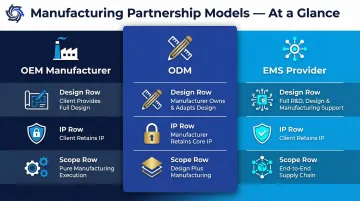
Not all ECMs operate the same way. The scope of services and who controls the design varies significantly across three primary models:
| Model | Design Responsibility | IP Ownership | Scope |
|---|---|---|---|
| OEM Manufacturer | Client provides complete design | Client retains full IP | Pure manufacturing execution |
| ODM | Manufacturer owns design or adapts existing solutions | Manufacturer retains core IP | Design + manufacturing |
| EMS Provider | Full R&D, design, and manufacturing support | Client retains IP (EMS executes) | End-to-end supply chain partner |
Manufacturers Working for OEMs (Original Equipment Manufacturers)
An OEM-serving ECM follows the client's complete design specifications—Gerber files, bill of materials (BOM), software, and testing protocols are all provided by the OEM. The ECM simply executes production: PCB fabrication, assembly, component sourcing, and testing, with no R&D or design autonomy.
Confidentiality agreements (NDAs) are standard in this model. Some large OEMs split production across multiple ECMs to protect proprietary designs—for example, Apple splits iPhone assembly between Foxconn (70%) and Pegatron (20%) to avoid single-supplier dependence and safeguard IP.
ODM (Original Design Manufacturer)
The ODM model flips the IP equation. Here, the manufacturer holds its own R&D capabilities and either adapts pre-designed solutions for the client's needs or develops products from scratch based on the client's concept. The client still sells the finished product under their own brand.
Unlike the OEM model, in ODM arrangements it is the manufacturer—not the client—who protects core technology and design IP. This model is common in consumer electronics where speed-to-market and cost efficiency outweigh the need for proprietary design control.
EMS (Electronic Manufacturing Services) Providers
EMS is the most comprehensive model—encompassing R&D, design, prototyping, PCB fabrication and assembly, component sourcing, testing, quality control, logistics, and post-sale maintenance. An EMS provider takes on the full scope of what most clients would otherwise manage across several separate vendors.
That said, these models aren't mutually exclusive. A single ECM can operate under different models for different clients simultaneously—acting as an OEM manufacturer for a client with complete in-house design capabilities, while serving as an ODM for a startup that needs turnkey product development.
Key Services ECMs Provide
Electronic contract manufacturers offer a range of services depending on their model and capabilities:
Core service categories:
- Design assistance and DFM (Design for Manufacturability) review — Feedback to optimize designs for production efficiency and cost
- PCB fabrication and PCBA — Printed circuit board manufacturing and assembly using SMT and through-hole technologies
- Component sourcing — Both turnkey (ECM sources all parts) and consignment (client supplies pre-kitted components)
- Enclosure and chassis fabrication — Custom metal housings, brackets, and structural components
- Box-build and system integration — Full assembly including wiring, firmware loading, and final product integration
- Functional testing and quality inspection — In-circuit testing (ICT), automated optical inspection (AOI), X-ray inspection, and final QC
Turnkey vs. Consignment Models
Turnkey manufacturing means the ECM sources all components and manages the entire supply chain. This model costs more per unit but cuts procurement overhead for the client. Turnkey saves 12–18% in management costs for mid-volume projects and reduces rework rates by 2–4x compared to consignment.
Consignment manufacturing means the client supplies pre-kitted components to the ECM. This gives clients more cost control, but demands significant internal procurement effort — and incoming material defects tend to push rework rates higher.
Either way, the ECM's role doesn't stop at electronic assembly. Products that need custom enclosures, chassis, or mounting hardware typically require mechanical fabrication alongside PCBA work.
Supporting Metal Fabrication Services
For products requiring custom metal enclosures, brackets, or structural chassis, clients often work with specialized metal fabrication shops alongside their ECM. For example, a metal fabrication partner like IMTS offers CNC machining, laser cutting, press brake forming, AWS-certified welding, powder coating, and full CMM inspection for the mechanical components that house or support electronic assemblies.
Key Benefits of Electronic Contract Manufacturing
Cost Reduction
Setting up an in-house SMT line requires millions in capital expenditure for advanced pick-and-place machines, reflow ovens, AOI systems, and automated warehouses. This equipment depreciates quickly as technology evolves. By outsourcing, OEMs convert fixed costs into variable costs—paying only for actual production time while avoiding the financial risk of underutilized assets.
Tier-1 EMS providers aggregate demand across hundreds of customers, giving them massive procurement leverage. For example, Jabil manages a network of 38,000 global suppliers, enabling access to better pricing, more reliable supply, and preferred component allocations during shortages.
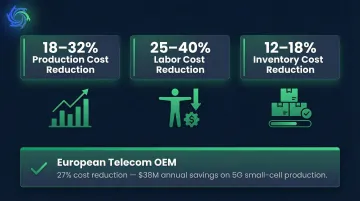
Real-world impact: In the telecom sector, outsourcing to EMS providers yields production cost reductions of 18–32%, labor cost reductions of 25–40%, and inventory holding cost reductions of 12–18%. One European telecom OEM outsourcing 5G small-cell production achieved a 27% production cost reduction and $38 million in annual savings.
Access to Specialized Expertise and Technology
EMS providers invest continuously in advanced equipment (SMT lines, AOI, X-ray inspection, reflow ovens) and maintain certified, skilled technicians. These capabilities would be prohibitively expensive for most brands to replicate in-house.
Critical certifications that define quality:
- IPC-A-610 (current revision: J-2024) — The most widely used electronics assembly acceptance standard
- IPC-7711/7721 (revision D) — Procedures for rework, modification, and repair
- ISO 9001:2015 — Foundational quality management system standard
- ISO 13485:2016 — Medical device quality management system
- AS9100 — Aerospace and defense quality management standard
- IATF 16949 — Automotive quality management system
Faster Time-to-Market
Partnering with an EMS provider can slash product launch timelines by 40–50%. UK OEMs have reduced typical launch cycles from 24 weeks down to 10–14 weeks through early collaboration, established supplier networks, and parallel engineering processes.
Design for Manufacturability (DFM) eliminates costly respins: Industry studies show that design decisions determine 70–80% of a product's total cost. Running DFM checks iteratively throughout design stages lets OEMs catch issues early, avoiding late-stage engineering change orders (ECOs), costly board respins, and schedule delays.
Supply Chain Resilience and Flexibility
During the 2020–2022 global semiconductor shortage, critical components experienced lead times extending beyond 30–52 weeks. EMS providers mitigate these disruptions through advanced supply chain management by using predictive analytics, AI-driven forecasting, and deep supplier relationships to make proactive sourcing decisions.
They provide BOM optimization, identify form-fit-function alternate components, and maintain supply stability even in volatile markets. Under a turnkey model, the EMS provider takes full ownership of sourcing and continuity—absorbing short-term carrying costs and reducing the OEM's exposure to disruptions and component obsolescence.
Focus on Core Competencies
By delegating manufacturing complexity to a specialist, the contracting company can concentrate resources on the work that actually moves the needle for their business. In practice, that means:
- Accelerating product roadmaps and R&D cycles
- Building stronger customer relationships and sales pipelines
- Investing in brand development and market positioning
- Responding faster to competitive shifts without manufacturing bottlenecks
Industries That Use Electronic Contract Manufacturing
Electronic contract manufacturing serves diverse sectors, each with distinct compliance and quality demands. The table below outlines the primary industries and what sets their requirements apart:
| Industry | Key Standards | What ECMs Must Deliver |
|---|---|---|
| Medical Devices | FDA 21 CFR Part 820 / ISO 13485:2016 | Full traceability, documentation, and patient safety. The FDA's QMSR now incorporates ISO 13485 by reference. |
| Military & Defense | MIL-SPEC, AS9100, ITAR | Certified handling of sensitive data; PCBs must meet specs like MIL-PRF-55110 for rigid board performance. |
| Automotive Electronics | IATF 16949 (builds on ISO 9001) | EV and ADAS growth has raised electronic complexity sharply — defect prevention and supplier quality controls are non-negotiable. |
| Industrial Controls | SEMI S2 | High-mix, low-volume (HMLV) precision with strict environmental, health, and safety compliance. |
| Consumer Electronics | IPC standards | High-volume output with fast design cycles and tight cost targets. |
| Semiconductor Capital Equipment | ISO 14644 (cleanroom) | Precision assembly in controlled environments with exacting machining tolerances. |

The complexity and compliance requirements vary significantly by industry—selecting an ECM with proven experience in your specific sector is critical for regulatory approval and product reliability.
How to Choose the Right ECM Partner
Selecting an EMS partner requires evaluating multiple dimensions beyond quoted price:
The 6 Critical Evaluation Criteria
1. Capabilities and Technology Depth Verify the ECM can handle SMT, through-hole technology (THT), box-build integration, and testing (ICT, AOI, X-ray) in-house. Ask for facility tours and equipment lists.
2. Quality Systems and Certifications Confirm ISO 9001, ISO 13485, AS9100, or IATF 16949 certification backed by complete traceability (e.g., IPC-1782). Request sample inspection reports or CMM data.
3. Production Volume Capacity and MOQ Ensure the ECM can scale from prototype (NPI) to full production. Clarify minimum order quantities and lead times for different volume tiers.
4. Supply Chain Strength Evaluate strategies to mitigate component shortages. Ask about supplier networks, BOM optimization services, and alternate component sourcing capabilities.
5. Industry Experience Prioritize ECMs with proven track records in your sector. Request case studies and customer references from similar applications.
6. Total Cost of Ownership (TCO) Evaluate the true cost, which includes acquisition cost, operation cost, logistics, and risk factors—not just the unit price.
Geographic Considerations: Nearshore vs. Offshore
| Factor | Offshore (e.g., Asia) | Nearshore (e.g., Mexico) |
|---|---|---|
| Cost | Lower labor costs, massive infrastructure | Reduced transportation costs, less ocean freight reliance |
| Lead Times | Longer (weeks for ocean shipping) | Shorter, faster time-to-market |
| IP Protection | Higher geopolitical risk, varying IP enforcement | Stronger IP protections via trade agreements (e.g., USMCA) |
| Collaboration | Time zone and language barriers | Shared business hours, cultural alignment |
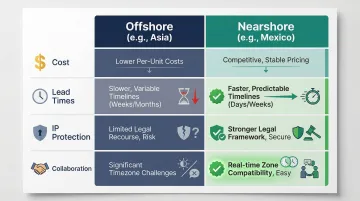
Offshoring remains the default for pure cost savings at massive volumes. For complex or high-reliability electronics, nearshoring tends to win on speed, collaboration, and supply chain flexibility.
Quality Culture Matters
Certifications tell you what a manufacturer claims. Culture tells you how they actually operate. Look for an ECM that catches problems before shipment rather than after, communicates openly, and has references from clients in similar industries.
When vetting partners, ask specifically about:
- How they handle design feedback and DFM recommendations
- Their process for managing engineering change orders
- Metrics they track for continuous improvement
Frequently Asked Questions
What is electronic contract manufacturing?
Electronic contract manufacturing is a business model where a company hires a specialized manufacturer to produce electronic products or assemblies on its behalf. The finished goods are sold under the client's brand, while the ECM handles production infrastructure, equipment, and labor.
What is the difference between EMS and contract manufacturing?
"Contract manufacturing" is the broader term for any outsourced production arrangement. "EMS" (Electronic Manufacturing Services) refers specifically to the most comprehensive category: providers that handle everything from design and procurement through production, testing, and logistics.
What services do electronic contract manufacturers typically provide?
ECMs typically cover PCB fabrication and assembly, component sourcing, enclosure fabrication, testing, box-build integration, and supply chain management. Exact scope depends on whether the provider operates as an OEM manufacturer, ODM, or full-service EMS provider.
What industries commonly use electronic contract manufacturing?
Key sectors include medical devices, defense, industrial controls, automotive, consumer electronics, and semiconductor equipment. Each carries distinct compliance requirements — such as ISO 13485, IATF 16949, or ITAR — that qualified ECMs must meet.
What is the difference between turnkey and consignment ECM?
Turnkey means the ECM sources all components, reducing your management overhead by 12–18% but increasing per-unit cost. Consignment means you supply pre-kitted parts, giving more cost control — though it typically requires more procurement effort and carries 2–4x higher rework rates.
How do I know if my company is ready to work with an ECM?
Companies typically turn to ECM partners when in-house production costs are rising, production volumes are scaling, specialized equipment is required, or faster time-to-market is a competitive priority. If you're facing any of these challenges, an ECM partnership may deliver measurable cost and speed advantages.