This guide explains what precision manufacturing is, how it works through specific processes like CNC machining and EDM, which industries depend on it for safety-critical applications, and how to evaluate a manufacturing partner's true precision capabilities. Whether you're sourcing components for medical devices or industrial equipment, understanding these fundamentals will help you make informed decisions that prevent costly failures downstream.
Key Takeaways
- Precision manufacturing produces components to tolerances as tight as ±0.0001 inches using computer-controlled equipment and structured inspection protocols
- Core processes include CNC machining, laser cutting, water jet cutting, grinding, EDM, and CMM inspection
- Medical, aerospace, defense, and automotive industries depend on precision manufacturing for safety-critical components where dimensional accuracy determines performance
- Repeatable processes cut scrap rates, improve product reliability, and shorten production lead times
- Choosing a partner means evaluating equipment range, metrology capabilities, certifications (AWS, ISO), and material sourcing practices
What Is Precision Manufacturing?
Precision manufacturing is a production approach that creates components to defined specifications—controlling micron-level accuracy, tight tolerances, and consistency across every part produced. Every dimension, surface finish, and geometric relationship is held to ensure parts function exactly as designed.
Understanding Tolerances
The concept of "tolerances" refers to the acceptable range of deviation from a specified dimension. While standard machining typically operates within ±0.005 inches, precision machining pushes dimensional control to ±0.001 inches, with ultra-precision applications reaching ±0.0001 inches (approximately 2.54 microns). That level of exactness matters because parts must mate precisely in assemblies—a shaft just 0.0002 inches oversized may bind in its bearing, causing premature wear or outright failure.
Accuracy, Precision, and Repeatability
Three distinct but related concepts define whether a manufacturing process qualifies as "precision":
- Accuracy: The process hits the specified dimension — a drawing calling for 2.0000 inches yields exactly 2.0000 inches
- Precision: That result holds consistently across multiple parts, with minimal variation between them
- Repeatability: The 1,000th part measures identically to the first, across the full production run
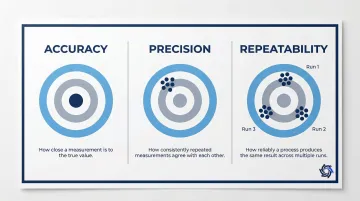
According to NIST standards, these distinctions are critical: a process can be precise (consistently hitting the same dimension) without being accurate (if that dimension is wrong), or accurate on average without being precise (if measurements scatter widely around the target).
The Role of CAD/CAM and CNC Technology
Achieving that accuracy and repeatability in practice depends on the technology running the process. Digital blueprints created in CAD (Computer-Aided Design) software drive machine behavior through CAM (Computer-Aided Manufacturing) systems, eliminating human error in the execution phase. CNC (Computer Numerical Control) technology translates these digital instructions into precise machine movements. Modern 5-axis CNC machines achieve positioning accuracies of 3 to 4 microns, with active thermal compensation systems that monitor and adjust for thermal expansion in real time.
Materials in Precision Manufacturing
Common metals used in precision manufacturing include:
- Aluminum (6061, 7075): Excellent machinability at 170-270% rating, lightweight, ideal for aerospace structures and heat sinks
- Steel (various grades): Versatile strength properties for structural components and industrial equipment
- Stainless Steel (304, 316): Corrosion resistance for medical instruments and marine applications, though challenging to machine (36-43% machinability rating)
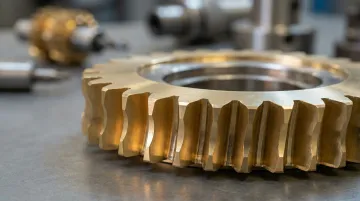
- Bronze: Good machinability for bearings and non-sparking components
- Titanium (Ti-6Al-4V): High strength-to-weight ratio for aerospace and medical implants, very difficult to machine (20% machinability rating)
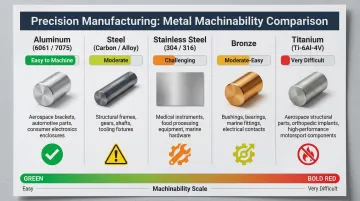
Specifying a ±0.0001-inch tolerance on titanium requires significantly more machining time and specialized tooling compared to the same feature in aluminum — a gap that directly affects both lead time and cost.
Core Processes of Precision Manufacturing
Achieving sub-micron precision means matching the right manufacturing process to each part's geometric and metallurgical requirements. The six core processes below cover how precision manufacturers cut, finish, join, and verify components — from raw stock to final inspection.
CNC Machining (Milling and Turning)
Computer-controlled mills and lathes remove material from a workpiece to achieve exact geometries. CNC milling creates complex shapes, pockets, and contours, while CNC turning produces cylindrical parts like shafts and bushings. This is the backbone of most precision manufacturing operations, supporting both prototyping and high-volume production.
IMTS operates Haas CNC mills ranging from large VF5 units (50" x 26" x 25" work envelope) to compact Mini Mills. Paired with turning centers featuring live tooling and bar feed automation, this range covers everything from small precision components to large structural assemblies.
Laser Cutting
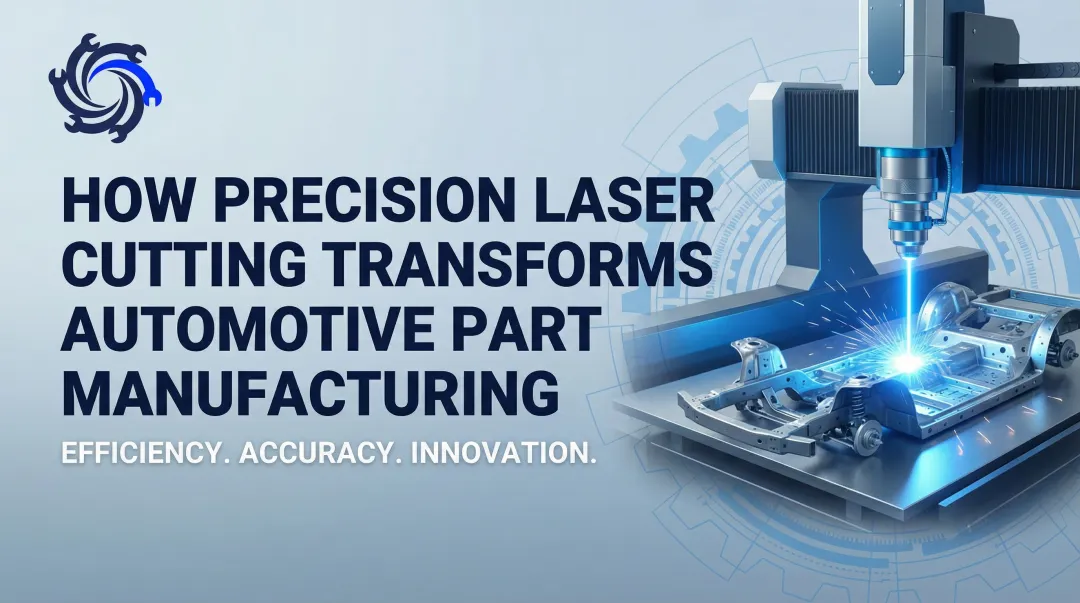
A focused laser beam cuts metal with minimal heat-affected zones and tight dimensional accuracy — ideal for intricate profiles and sheet metal components. Fiber lasers achieve tolerances between ±0.03 mm and ±0.1 mm with exceptional speed and low material waste.
One caveat: lasers melt material during cutting, creating a Heat-Affected Zone (HAZ) that can cause thermal distortion and microcracking. For applications requiring pristine metallurgical properties, alternative processes may be preferable.
Water Jet Cutting
High-pressure water streams — often mixed with abrasive particles — cut metals without heat, completely preserving material integrity. Waterjets hold tolerances of ±0.003 to ±0.005 inches, and up to ±0.001 inches on thinner materials, making them especially valuable for heat-sensitive metals like titanium or hardened steels where thermal distortion would compromise performance.
IMTS's Omax Maxium 1530 water jet system covers a 5'×10' cutting area and handles any material composition at any thickness — including materials that would crack, warp, or harden under a laser's heat.
Grinding and Finishing
Surface grinding achieves ultra-smooth finishes and exact dimensional tolerances that machining alone may not reach. Precision CNC grinding routinely produces finishes from 32 microinches Ra down to 4.0 microinches Ra, a significant improvement over milling's typical 32–125 microinches Ra.
Finishing services build on that precision. Media blasting (glass bead or coal slag) prepares surfaces for coating, and powder coating seals and protects the final part. IMTS's cure oven (106" x 60" x 90") handles substantial assemblies, with iron phosphate chemical film washing for added corrosion protection.
Welding and Assembly
Certified welding joins precision components while maintaining the same quality standards as the machined parts themselves. AWS D1.1 (Structural Steel) and AWS D17.1 (Aerospace) codes require strict documentation through Welding Procedure Specifications (WPS) proven by destructive testing recorded in Procedure Qualification Records (PQR).
IMTS's AWS-certified welders work across three processes:
- MIG welding — high-speed joining for structural and production work
- TIG welding — precision welds on stainless steel using Miller Dynasty 300 systems
- Spot welding — fast, localized fusion for sheet metal assemblies
Handling machining, welding, and assembly under one roof reduces handoffs and quality risk while accelerating project timelines.
Inspection and Metrology
Coordinate Measuring Machines (CMM) verify that finished parts meet drawing specifications. Stationary bridge CMMs achieve accuracies of 1.5 + L/350 microns, while portable articulated arms offer shop-floor flexibility at approximately 24 microns accuracy.
The distinction matters: portable arms cannot reliably validate ±0.0001-inch tolerances that stationary CMMs routinely measure. IMTS uses both — a Keyence XM-5000 portable CMM for on-site inspection and a Starrett HGC 1820-16 stationary CMM for final validation, plus Keyence IM-8000 imaging systems for detailed dimensional analysis. Full inspection reports provide the traceability required for medical, aerospace, and defense applications.
Industries That Rely on Precision Manufacturing
The global precision machining market reached $123.54 billion in 2025 and is projected to grow to $228.75 billion by 2033, driven by demand for tighter tolerances and complex geometries across critical sectors. driven by demand for tighter tolerances and complex geometries across critical sectors. Four industries account for the bulk of that demand.
Aerospace and Defense
The aerospace parts manufacturing market is projected to reach $1.23 trillion by 2030. Components like turbine blades, landing gear, and structural assemblies require zero tolerance for error—a single out-of-spec part can compromise flight safety. The U.S. Department of Defense actively invests in domestic precision machining capacity to secure production of microelectronics, munitions, and forged components, reducing foreign supply chain dependency.
Medical and Surgical
Implants, surgical instruments, and diagnostic equipment operate under some of the strictest manufacturing standards in any industry. One micron of deviation can affect patient outcomes in applications like leadless pacemakers and neuro-stimulators. Key requirements include:
- FDA Quality Management System Regulation and ISO 13485 compliance for all medical devices
- Sub-micron tolerances on implantable components where dimensional drift affects function
- ASTM F136 — governs the chemical and mechanical properties of Titanium Ti-6Al-4V ELI used in surgical implants
Automotive and Industrial Equipment
High-performance engine components, transmission parts, and heavy machinery depend on precision-manufactured parts for longevity and performance. Custom fabrication shops serving industrial clients often produce one-off and short-run components where dimensional accuracy directly impacts equipment uptime and maintenance costs. Common examples include:
- Crankshafts and cylinder heads machined to tight surface finish specs
- Gearbox housings requiring bore alignment within tenths of a thousandth of an inch
- Hydraulic valve bodies and fluid control components
- Heavy equipment frames and structural weldments with critical fit-up requirements
Electronics and General Commercial
Circuit board hardware, enclosures, and custom mechanical assemblies address broad commercial demand. As devices continue to shrink, precision requirements in consumer and industrial electronics are converging — connectors, heat sinks, and housings that once held millimeter tolerances now routinely require features measured in microns.
Key Benefits of Precision Manufacturing
Reduced Waste and Lower Rework Costs
Tight tolerances mean fewer rejected parts, less scrap material, and fewer costly rework cycles. Case studies from NIST's Manufacturing Extension Partnership demonstrate that implementing advanced CNC systems reduces setup times by up to 50% and significantly drops scrap rates, translating directly to lower per-unit cost over time.
High process capability (Cpk) measures how well a process stays within specification limits — the higher the Cpk, the lower the defect rate. This translates to fewer Parts Per Million (PPM) failures and lower lifecycle costs across the production run.
Improved Product Reliability and Longevity
Precision components fit together correctly the first time and wear more evenly over time. Proper dimensional control ensures uniform load distribution, reducing stress concentrations that cause premature failure. This leads to longer service life for end products and reduced warranty or maintenance costs for customers.
Faster Time-to-Market Through Repeatability
Once a precision manufacturing process is validated, manufacturers can replicate production runs consistently without re-qualification. First Article Inspections (FAI) pass faster, allowing OEMs to ramp up production without costly trial-and-error iterations. This repeatability accelerates New Product Introduction (NPI) and enables on-time delivery.
Precision Manufacturing vs. Traditional Manufacturing
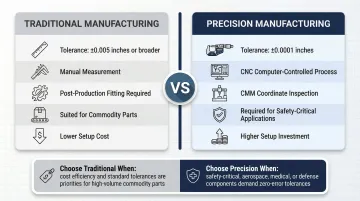
The core difference lies in dimensional control and process execution. Traditional manufacturing typically accepts tolerances of ±0.005 inches or broader, relying on manual measurement and post-production fitting. Operators adjust parts based on experience and caliper readings.
Precision manufacturing demands far tighter specs—often ±0.0001 inches—enforced by computer-controlled equipment and rigorous inspection using CMM technology.
Choosing between the two approaches depends on what the part actually needs to do:
- Traditional methods suit low-precision, high-volume commodity parts where exact dimensions don't affect function
- Precision manufacturing justifies higher setup costs when accuracy is critical to function, safety, or regulatory compliance
- High-stakes applications—medical implants, aerospace structural components, high-performance automotive parts—leave no margin for dimensional error
CNC technology has steadily narrowed the gap between the two approaches. Small and mid-size shops can now achieve precision-level quality without large-volume commitments—capabilities that were once exclusive to aerospace and defense contractors. For industrial buyers, this means more sourcing options and less pressure to compromise on tolerances to control cost.
How to Choose the Right Precision Manufacturing Partner
Equipment Breadth and In-House Capability
A manufacturer who handles CNC machining, laser cutting, water jet, welding, forming, and finishing under one roof eliminates the need for multiple vendors, reduces lead times, and minimizes quality risk from handoffs. Fragmented supply chains multiply risk through sequential failures and coordination breakdowns, whereas vertically integrated manufacturers maintain consistent quality control from raw material to finished part.
Look for shops with transparent, published equipment lists. IMTS maintains comprehensive capabilities including multiple CNC mills and lathes, Bescutter 510 Fiber Laser (3kW, 5'×10'), Omax Maxium 1530 water jet, Amada press brakes, AWS-certified welding, and powder coating—all supported by advanced metrology equipment.
Inspection and Quality Assurance Standards
Ask whether the manufacturer provides full inspection reports and what metrology equipment they use. CMM capability signals serious commitment to verifiable quality. Distinguish between portable arms (suitable for shop-floor verification) and stationary bridge CMMs (required for validating ±0.0001-inch tolerances).
Request proof of AWS certification as a concrete quality signal. AWS certification requires documented Welding Procedure Specifications backed by destructive testing, ensuring repeatable weld quality and preventing regulatory non-conformances.
Material Sourcing and Cost Transparency
Manufacturers who source materials locally or through long-standing supplier partnerships can offer more competitive pricing and faster turnaround. Ask how material costs are communicated and whether the shop will work with materials you supply.
IMTS sources materials through long-term local supplier partnerships—a practice that keeps costs competitive and lead times short. Their 16-foot box truck also handles material pickup and delivery directly, removing one more coordination step from your project.
Communication and Partnership Approach
The best precision manufacturing partners maintain open communication about project status, constraints, and trade-offs. Look for shops that will flag design-for-manufacturability issues early rather than simply running what's on the drawing—this saves significant cost downstream.
Concrete signs of a strong partnership approach include:
- Proactively flagging design-for-manufacturability issues before cutting begins
- Offering alternatives when a tolerance or material spec drives unnecessary cost
- Providing clear timelines and status updates without prompting
- Discussing process trade-offs openly rather than just running the drawing
IMTS treats open communication as a core operating principle—which means fewer surprises and more predictable outcomes on complex jobs.
Frequently Asked Questions
What is precision manufacturing?
Precision manufacturing is the production of components to extremely tight dimensional tolerances—often ±0.0001 inches—using advanced computer-controlled machines, strict quality control, and verified inspection through CMM technology. It ensures every part meets exact specifications consistently across production runs.
What are the processes of precision manufacturing?
Core processes include CNC machining (milling and turning), laser cutting, water jet cutting, surface grinding, EDM (Electrical Discharge Machining), AWS-certified welding, and CMM inspection. Full-service contract manufacturers handle all of these under one roof, which eliminates vendor coordination and reduces lead times.
Is precision manufacturing made in the USA?
Yes, precision manufacturing is a strong domestic industry in the U.S., with over 265,000 workers employed in machine shops nationwide. Thousands of shops across the country produce precision components for aerospace, defense, medical, and industrial clients. Choosing a domestic manufacturer offers benefits in lead time, communication clarity, and quality accountability.
What is the difference between precision manufacturing and traditional manufacturing?
Precision manufacturing enforces tighter tolerances (often ±0.0001 inches) using computer-controlled equipment and rigorous CMM inspection, while traditional manufacturing may accept broader variation (±0.005 inches or more) and rely more on manual processes and fitting. Precision manufacturing is the right choice when component accuracy is safety- or performance-critical.
What materials are used in precision manufacturing?
Common metals include steel, aluminum, stainless steel, bronze, and titanium. Material selection depends on application requirements—aluminum machines easily and suits general fabrication, while titanium's superior strength-to-weight ratio makes it ideal for aerospace and medical parts despite its higher machining complexity.
How do I know if precision manufacturing is right for my project?
Consider whether your part has tight fit or function requirements, whether failure carries safety or performance consequences, and whether consistency across a production run is critical. If yes to any of these—or if your application involves regulatory compliance in medical or aerospace—precision manufacturing is the appropriate approach.