Introduction
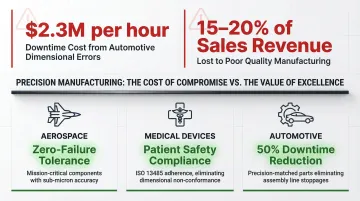
A single out-of-spec component can trigger catastrophic system failures, costly product recalls, or safety hazards across industries—from medical devices to heavy machinery. According to recent industry data, the hidden costs of poor quality consume 15% to 20% of a company's total sales revenue, while automotive manufacturers face unplanned downtime costs of $2.3 million per hour when dimensional errors reach the assembly line. This urgent need for parts made with exact, repeatable accuracy drives demand for precision manufacturing.
Precision manufacturing is the process of producing components to extremely tight dimensional specifications, enabling parts to fit, function, and perform reliably in critical applications.
This article covers what precision manufacturing is, how it works, which industries depend on it, and how it fuels industrial innovation. As global manufacturing grows more complex and competitive, any business sourcing or specifying custom parts needs to understand it.
TLDR:
- Precision manufacturing produces components to tolerances as tight as ±0.001" using CNC machining and advanced processes
- CNC machining, laser/waterjet cutting, welding, and CMM inspection are the core processes
- Aerospace, medical, and automotive sectors rely on precision parts where failure is not an option
- Tighter tolerances enable miniaturization, accelerate prototyping, and reduce system failures
- Choose partners offering full-service capabilities, documented inspection reports, and AWS-certified welding
What Is Precision Manufacturing?
Precision manufacturing is a production method in which materials—typically metals, but also plastics and composites—are machined, cut, or formed to precise dimensions with tolerances often measured in thousandths of an inch or microns. These operations use CNC-guided equipment to achieve exact specifications repeatedly across every part produced.
Precision vs. Standard Manufacturing
Conventional manufacturing allows broader dimensional tolerances and accepts more variation between parts—suitable for less critical applications. Precision manufacturing demands tight consistency across every unit, making it non-negotiable for safety-critical or performance-critical work.
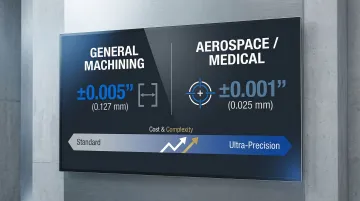
The difference shows up clearly in tolerance requirements:
| Application | Typical Tolerance |
|---|---|
| General machining | ±0.005" (0.127 mm) |
| Aerospace / Medical components | ±0.001" (0.025 mm) or tighter |
Understanding Tolerances
Tolerances define the acceptable range of deviation from a specified dimension. Tighter tolerances are significantly harder to achieve and require more specialized equipment, skill, and inspection. Moving from ±0.05 mm to ±0.02 mm may raise costs by 50%, but tightening further to ±0.01 mm can multiply costs several times over due to slower feed rates, thermal controls, and 100% inspection requirements. That cost premium is the price of parts that perform reliably in assemblies where failure isn't an option.
What "Precision Parts" Means
Precision parts are components engineered to meet exact specifications so they fit, function, and perform reliably in assembly with other parts—whether that's a gear in a gearbox, a bracket in an aircraft, or an implant in the human body. These parts must maintain dimensional accuracy across production runs to ensure consistent performance.
Evolution of Precision Manufacturing
The shift from manual machining to computer-controlled processes redefined what manufacturers could achieve. In 1952, a team at MIT demonstrated the first prototype Numerical Control (NC) milling machine using punched tape to cut complex 3D shapes. Today, digital design tools (CAD/CAM) and automated inspection drive the process. Real-time quality monitoring ensures parts meet specifications before they leave the shop floor.
Key Processes and Technologies in Precision Manufacturing
CNC Milling and CNC Turning
CNC (Computer Numerical Control) machining drives the majority of precision part production. CNC mills use rotating cutting tools to remove material from a stationary workpiece, creating complex features, pockets, and contours. CNC lathes rotate the workpiece against a stationary cutting tool — ideal for cylindrical parts like shafts, bushings, and threaded components. Together, they produce complex 3D geometries with tight tolerances and high repeatability.
While tolerances of ±0.002" to ±0.005" are routine, holding ±0.001" or tighter requires strict process control — including thermal management, precision fixturing, and advanced toolpath strategies.
IMTS operates an extensive CNC fleet with work envelopes ranging from compact 16"×12"×15" Mini Mills to large 50"×26"×25" machining centers, equipped with live tooling, sub-spindles, and bar feeds for broad versatility across part sizes and geometries.
Laser Cutting and Water Jet Cutting
These cutting technologies offer distinct advantages depending on material and thickness:
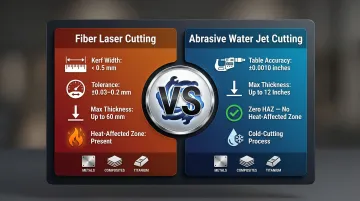
Fiber Laser Cutting uses a high-powered focused beam to slice through metal with minimal kerf width (< 0.5 mm) and achievable tolerances of ±0.03 mm to ±0.2 mm. Ideal for rapid profiling of sheet metals up to 60mm thick, lasers deliver excellent edge quality and tight tolerances. However, they create Heat-Affected Zones (HAZ) that may require secondary finishing.
Abrasive Water Jet Cutting uses high-pressure water mixed with abrasive to cut almost any material up to 12 inches thick with table accuracy of ±0.0010" and zero HAZ. This cold-cutting process preserves material properties, making it ideal for heat-sensitive, highly reflective metals (copper, titanium) or applications where thermal distortion is prohibited. IMTS operates an Omax Maxium 1530 system that excels at producing intricate geometries while maintaining dimensional accuracy across thick materials.
Welding and Forming
AWS-Certified Welding ensures weld integrity meets industry standards. The AWS D1.1 Structural Welding Code governs fabricating and erecting welded steel structures, covering material preparation, workmanship, and non-destructive testing acceptance criteria. IMTS performs MIG, TIG, and spot welding under AWS certification. This matters most for structural components in medical equipment, industrial frameworks, and automotive fixtures — applications where weld failure is not an option.
Metal Forming processes like bending and pressing shape materials without removing metal. High-capacity press brakes (such as IMTS's 90-ton Amada systems) produce precise bends, angles, brackets, and frames with excellent repeatability — essential for structural components that must maintain dimensional accuracy across production runs.
Finishing Services
Post-machining processes bring parts to final specification:
- Media Blasting (glass bead, coal slag) removes scale, oxidation, and surface contaminants to prepare surfaces
- Powder Coating delivers durable, uniform finishes that enhance corrosion resistance and appearance
- Chemical Film Washing (iron phosphate treatment) provides corrosion protection and enhances coating adhesion
IMTS offers comprehensive finishing services including a large-capacity cure oven (106"×60"×90") that accommodates substantial component sizes, ensuring parts are production-ready with protective finishes.
Inspection and Quality Control
CMM (Coordinate Measuring Machine) inspection is the critical final step, measuring part geometry against design specifications with high accuracy. ISO 10360-2 compliant CMMs feature advanced capabilities like linear motors and independent axis thermal compensation, enabling sub-micron volumetric accuracy.
Next-generation CMMs are moving from climate-controlled labs directly to the shop floor, enabling in-line probing and closed-loop quality assurance. IMTS utilizes both portable CMMs (Keyence XM-5000) and stationary systems (Starrett HGC 1820-16), plus advanced imaging measurement systems (Keyence IM-8000) to provide full inspection reports with documented quality assurance before parts leave the facility.
Industries That Rely on Precision Manufacturing
Aerospace and Defense
Aerospace components—landing gear parts, structural brackets, hydraulic fittings—demand the tightest tolerances of any industry, where a single out-of-spec part can trigger catastrophic failure. AS9100 governs quality management for the sector, adding aerospace-specific requirements around configuration management, product safety, and counterfeit parts prevention.
Before full production, suppliers must execute AS9102 First Article Inspections (FAI) to verify parts conform to engineering drawings. Defense applications carry the same zero-tolerance standard, with traceability documentation required at every production stage.
Medical and Healthcare
Precision manufacturing produces surgical instruments, orthopedic implants, and diagnostic equipment where dimensional accuracy directly impacts patient safety. Manufacturers must comply with FDA 21 CFR Part 820 and ISO 13485, emphasizing risk management and strict traceability. Material selection is equally critical. Implant-grade materials must clear strict chemical and mechanical thresholds:
- ASTM F136 titanium alloy — the standard for load-bearing orthopedic implants
- Surgical-grade stainless steel — used for instruments and short-term implants
- UHMWPE and PEEK polymers — common in joint replacement components
Each material choice feeds directly into biocompatibility testing and traceability requirements.
Automotive and Industrial Machinery
From engine components and drivetrain parts to custom machine parts and industrial equipment, precision-manufactured parts keep vehicles and heavy machinery running reliably. The failure of a single out-of-spec component can halt automotive production, costing manufacturers an estimated $2.3 million per hour. Precision parts reduce downtime, extend service life, and enable predictive maintenance strategies that cut unplanned downtime by up to 50%.
How Precision Manufacturing Drives Industrial Innovation
Enables Product Miniaturization and Complexity
Tighter tolerances and multi-axis CNC capabilities allow engineers to design smaller, lighter, and more complex components that were previously impossible to manufacture. Micro CNC machining achieves tolerances as tight as 1 micron (0.001mm) using 45,000-rpm spindles and thermal stabilization, unlocking advances in electronics, aerospace, and medical devices where miniaturization is critical.
Accelerates Prototyping and Product Development
Precision CNC machining allows rapid prototyping of functional parts—not just design mockups. Domestic CNC prototyping delivers complex machined parts in 5 to 10 business days, enabling engineers to test, iterate, and validate designs faster. This compresses product development timelines and reduces cost-to-market, allowing teams to execute Engineering Validation Tests (EVT) and Design Validation Tests (DVT) before committing to expensive high-volume production.
Improves Reliability and Reduces System Failures
Parts made to precise specifications fit and function as designed, reducing wear, vibration, and mechanical stress. Consistent tolerances across a production run produce measurable operational gains:
- Fewer unplanned system failures and downtime events
- Lower maintenance costs over the component's service life
- Reduced mechanical stress that extends assembly longevity
Supports Advanced Automation and Industry 4.0
Precise, repeatable parts are the foundation for automated assembly lines, robotics, and IoT-connected machinery. Even minor dimensional variation can disrupt automated processes. On-machine probing and shop-floor CMMs enable near-real-time measurement and closed-loop quality assurance. Systems adjust parameters on the fly, reduce scrap, and support lights-out automated manufacturing without constant operator intervention.
What to Look for in a Precision Manufacturing Partner
Full-Service Capabilities Under One Roof
Working with a shop that handles machining, cutting, welding, finishing, and inspection in-house eliminates coordination delays, reduces shipping risk between vendors, and keeps accountability in one place. IMTS covers the full production spectrum from their Marathon, NY facility:
- CNC milling and turning (work envelopes from 15"×12"×14" to 50"×26"×25")
- Fiber laser cutting (up to ¾" steel)
- Water jet cutting (up to 12" thick materials)
- Press brake forming (90-ton capacity)
- AWS-certified welding (MIG, TIG, and spot)
- Powder coating (106"×60"×90" oven)
- CMM inspection for dimensional verification
That coverage — from raw material receipt through final inspection — keeps lead times short and removes the handoff risk that comes with juggling multiple vendors. IMTS also runs an in-house 16' box truck for daily material pickup and delivery, adding another layer of logistics coordination most shops can't offer.
Certifications, Quality Standards, and Inspection Processes
AWS-certified welding, documented inspection reports with CMM equipment, and a 100% satisfaction guarantee are markers of a shop that takes quality seriously. Buyers should demand:
- ISO 9001:2015 for baseline quality management systems
- AS9100 & AS9102 FAI for aerospace/defense applications
- ISO 13485 for medical device components
- NADCAP accreditation for critical processes like heat treating and chemical coatings
- NIST-traceable CMM calibration certificates
Ask for documented inspection data, not just verbal assurances. IMTS provides full inspection reports using portable and stationary CMM equipment, ensuring parts meet specifications before delivery.
Communication, Responsiveness, and Local Sourcing
Once certifications check out, the softer factors — communication, responsiveness, and sourcing relationships — often determine whether a project actually finishes on time and on budget. Only 30% of OEMs use Total Cost of Ownership (TCO) models, often underestimating offshore costs by 20-30%. When OEMs shift to comprehensive TCO analysis, the win rate for U.S. domestic manufacturing jumps from 8% to 32%.
IMTS operates on the principle that "the best business is business done locally," which translates to competitive material costs through established regional supplier relationships. Their trucking service runs daily (available 5pm–8pm), keeping both prototype and production schedules moving without relying on third-party freight.
Geographic proximity between engineering and manufacturing teams also matters: it enables faster feedback loops, reduces miscommunication, and keeps proprietary designs in fewer hands.
Frequently Asked Questions
What is precision parts manufacturing?
Precision parts manufacturing is the process of producing components to exact dimensional specifications using advanced machining and cutting technologies. Each part meets tight tolerances (often ±0.001" or tighter) required for proper fit and function in critical applications like aerospace, medical devices, and industrial equipment.
Is precision manufacturing made in the USA?
Yes, there is a strong tradition of precision manufacturing in the USA. According to U.S. Census Bureau data, there are 17,156 machine shop establishments employing 223,313 workers. Many shops—including small and mid-size custom fabricators like IMTS—offer domestic production with advantages like faster lead times, easier communication, and no overseas shipping delays or quality uncertainties.
What tolerances are typical in precision manufacturing?
Tolerances vary by application. General machining typically holds ±0.005" (0.127 mm), while high-precision aerospace or medical components require ±0.001" (0.025 mm) or tighter. Ultra-precision or micro-machining can achieve ±0.0002" (5 microns) or even 1 micron under strictly controlled thermal conditions.
What is the difference between precision manufacturing and standard manufacturing?
Standard manufacturing accepts wider dimensional variation and suits less critical applications where exact fit isn't essential. Precision manufacturing demands consistent accuracy to tight tolerances, specialized CNC equipment, and CMM-verified inspection—making it essential for safety-critical or high-performance components.
How does CNC machining relate to precision manufacturing?
CNC machining is the most common method used in precision manufacturing. Computer-controlled machines execute programmed instructions to cut, mill, or turn materials with high repeatability—eliminating human variation and enabling complex geometries impossible to achieve manually.
Ready to discuss your precision manufacturing needs? Contact IMTS at (607) 345-3050 or info@imtsny.com to learn how our comprehensive capabilities—from CNC machining and laser cutting to AWS-certified welding and CMM inspection—can deliver the precision parts your application demands.